The Risky Pipeline-Boom
Written by: Prof. Dr. Dr. Felix Ekardt, University Leipzig & Simone von Kampen, BUND NRW
This article was originally published in German in Tagesspiegel Background on September 24, 2026.
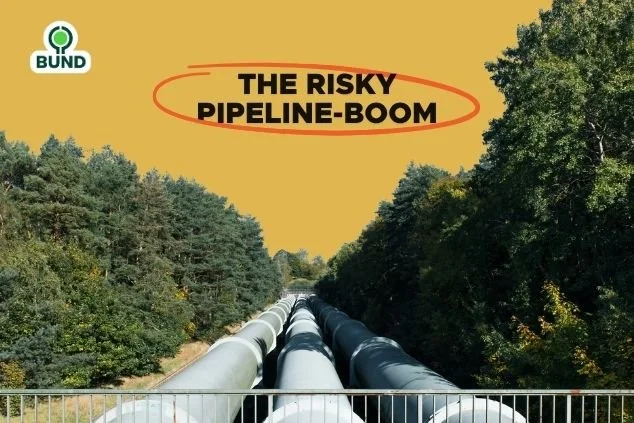
Thousands of kilometres of CO2 pipelines are planned to be built in Germany. Their safety is not ensured, warn Felix Ekardt, sustainability researcher, and Simone von Kampen, political director of BUND North Rhine-Westphalia.
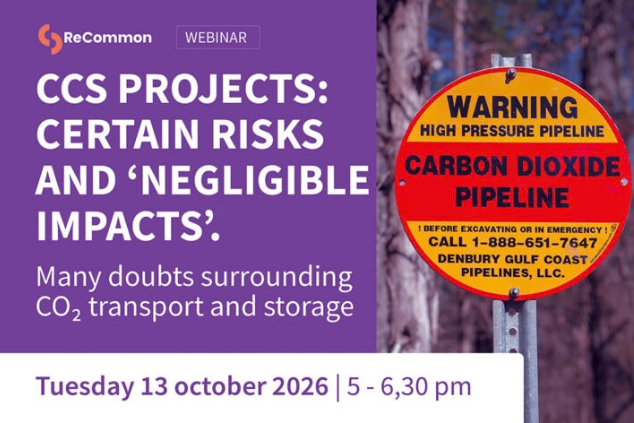
Germany is facing a massive infrastructure project, that hardly anyone has taken notice of: a network of carbon dioxide pipelines, several thousand kilometres long, some of which will run through densely populated areas, is set to be built in the coming years. The impetus for this is the Carbon Storage and Transport Act, which is designed to keep fossil fuels on the market indefinitely instead of bringing about a genuine energy transition. The Act establishes the legal framework for the capture, transport, and storage of CO₂ – known as CCS, or Carbon Capture and Storage.
This technology, however, has so far proved ineffective and is therefore no substitute for a genuine energy transition that protects the climate through zero emissions, frees us from dependence on authoritarian states, and safeguards our prosperity against rising energy prices. Nevertheless, substantial subsidies from the German government are intended to establish CCS, and companies are now applying for permits for such facilities in many locations.
The draft regulation on carbon dioxide pipelines is now available, a regulation that is intended to establish the technical rules for the transport of this climate-damaging gas. A sober assessment of this draft shows that the regulation equates carbon dioxide pipelines with high-pressure natural gas pipelines across the board. This equivalence is not factually tenable – and it creates a hazardous situation for which there is neither a basis in experience nor adequate regulation.
A gas with its own risks
Carbon dioxide is not natural gas. The differences are not just a technical detail for experts but are critical to safety. CO₂ is heavier than the air we breathe. If it escapes, it sinks, accumulates in low-lying areas, basements, and valleys, and displaces oxygen. A leak can create an invisible cloud within minutes that spreads for kilometres in calm conditions – without any smell or warning. People and animals caught in this cloud will suffocate without realising the danger.
Internal industry modelling illustrates the scale of the problem. Simulated accidents involving the loading of ships with liquid CO₂ show the CO₂ cloud extending five kilometres. Footage of a controlled rupture of a carbon dioxide pipeline documents the force of such a release: the freezing of the surrounding air and the widespread dispersion of the gas. It is for these reasons that, at an expert hearing of the European Parliament’s Environment Committee in January 2026, a recommendation was made not to construct carbon dioxide pipelines near populated areas.
Reality confirms the model calculations. In Germany, in 2008, more than a hundred people were injured in Mönchengladbach when CO₂ leaked from a faulty fire-extinguishing system. In the US, numerous accidents involving CO₂ pipelines have been documented over the past two decades. The most serious incident occurred in 2020 in the state of Mississippi: following a pipeline rupture, dozens of people suffered from the effects of asphyxiation – even though they were more than a kilometre away from the site of the rupture. Cars and emergency vehicles came to a standstill because their engines would no longer run in the oxygen-depleted air.
A technology with no empirical basis
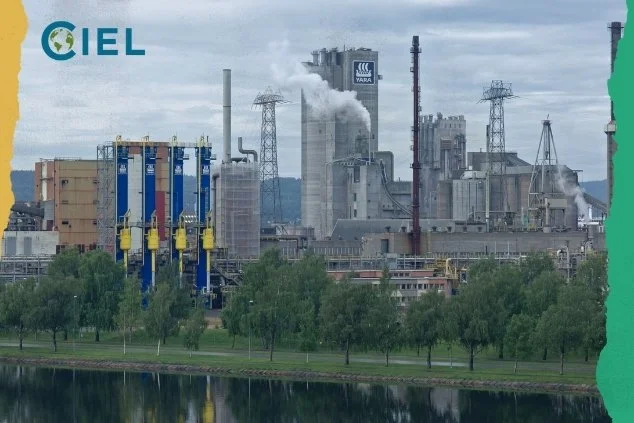
A second issue exacerbates the situation. The law stipulates that carbon dioxide pipelines must be constructed in a non-discriminatory manner. Whilst this sounds fair, it means that it is not purified CO₂ that is transported, but rather exhaust gas mixtures containing impurities from refineries, waste incineration plants and cement works. Such networks are not in operation anywhere in the world. CEN, the European standardisation organisation responsible for safety standards, has publicly stated that, due to a lack of experiences with such networks, it is unable to provide sufficiently detailed safety requirements for such pipelines. In an open letter, the organisation warns of unpredictable chemical reactions, uncontrollable corrosion of up to ten millimetres per year, and cracking in the pipelines.
Then there is the issue of cost pressures. High-quality steel, or the complex process of purifying the captured gas, would make CCS significantly more expensive. Leaks at an underground CO₂ storage site in the US state of Illinois – which only came to light in 2024 following regulatory inspections and led to a moratorium – have once again brought the issue of corrosion into sharp focus. It would be naïve to assume that the companies involved would voluntarily opt for the more expensive option as long as legislation does not oblige them to do so. Effective safety requirements and liability rules are therefore not merely a bureaucratic formality, but an essential measure for public safety.
What is at stake in North Rhine-Westphalia
This is particularly evident in the case of the Delta-Rhine Corridor, a 200-kilometre pipeline planned by Open Grid Europe. It will run from Gelsenkirchen and Cologne via Duisburg to Venlo and on to the Dutch North Sea, right through the densely populated Ruhr region. The area under consideration encompasses more than 20 districts and independent cities. Construction is being justified on the grounds of unavoidable residual emissions, such as those from the cement industry. However, the pipeline begins at refinery and chemical sites, where CO₂ is produced through the use of fossil fuels. This could be avoided by using renewable energy, electrifying processes and adopting a circular economy approach. Furthermore, virtually all other emissions can be avoided, and where they cannot, wetlands and forests sequester them more effectively.
For local residents, the situation is even more imbalanced. Above the pipeline lies a ten-metre-wide protective strip secured in the land register where building is prohibited. During construction, a further 40 metres of working strip will be added, and the new law has made expropriation easier. A gas mixture will flow through the pipelines at a pressure of 200 bars, the corrosive effect of which is uncertain. The risks and loss of land are localised, while the benefits accrue to companies responsible for a large proportion of the region’s emissions. It is also worth noting that the project contradicts North Rhine-Westphalia’s carbon management strategy, which, like the Intergovernmental Panel on Climate Change (IPCC), explicitly classifies CCS as a supplementary measure of last resort and advises against power stations connecting to a CO₂ network.
Furthermore, the planned route cuts right through areas that are essential for sustainable climate protection, such as forests, floodplains, swamp forests and wetlands. The rewetting of these areas would permanently sequester CO₂. According to Germany’s Climate Protection Act, natural carbon sinks are given priority over technical ones. Sacrificing these areas for CO₂ pipelines not only raises nature conservation concerns, but also effectively reverses the priorities set out in law.
What should be done
A ban on CCS would be necessary. Residual emissions can be sequestered in wetlands and forests. With due recognition to this overarching concern, carbon dioxide pipelines should in any case only be built if they are genuinely safe. It is not enough simply to adopt existing rules for natural gas pipelines. Firstly, CO₂ must be included in the list of substances covered by the Major Accidents Ordinance, so that pipelines and transport facilities are subject to the same major accident regulations as other facilities with a comparable risk potential.
Secondly, accidents require clear liability rules that hold those responsible for the accident to account, not the municipalities. Thirdly, the public, emergency services and licensing authorities must be systematically informed about the risks and associated costs – most towns and districts are as yet unaware of what lies ahead. Finally, technical standards should not be limited to generally accepted engineering principles, but, given the lack of experience in this area, should be raised to the level of the current state of the art in science and technology.
Prof. Dr Dr Felix Ekardt heads the independent Research Unit Sustainability and Climate Policy in Leipzig and is chair of BUND (= Friends of the Earth Germany) Saxony. Simone von Kampen is political director of the BUND North Rhine-Westphalia.
The views and opinions expressed in the publication are those of the mentioned organisation and do not necessarily reflect the position of all Real Zero Europe members.
Related resources: