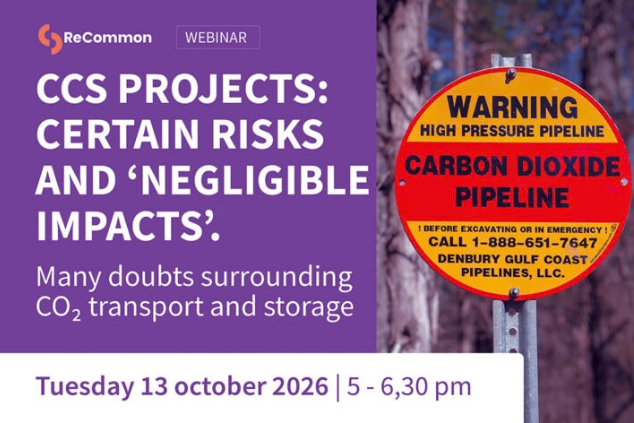
CCS projects: certain risks and ‘negligible impacts’
In collaboration with ReCommon.
13 October 2026
5.00–6.30 pm CEST
Many doubts surrounding CO₂ transport and storage, in Italy and abroad.
Last January, the Italian government granted environmental approval for the CCS Pianura Padana (Po Valley CCS project). One hundred kilometres of pipelines to transport CO2 are merely the first step in a larger project, promoted by Eni and Snam, which will see the area between Ferrara and Ravenna become the main hub of a ‘Mediterranean hub’ for the capture, transport and storage of CO2, known as Callisto.
These infrastructure will carry up to 4 million tonnes of CO2 per year in Phase 2 of the project, and up to 16 in the following ones, produced by polluting industries in the Po Valley and even from France, before injecting it into depleted gas fields in the northern Adriatic, off the coast of Ravenna.
But in addition to questions about whether or not the project should be funded with public money and about its actual effectiveness, we must take into account the track record of similar projects, which has been marked by accidents and risks to human health and ecosystems. This is the case with the nearly 1,500-kilometre ‘carbon pipeline’ running through Louisiana, Texas and Mississippi, operated by ExxonMobil. Snam, the promoter of the CCS Pianura Padana, claims that the likelihood of a rupture in a pipeline of this type is minimal; yet, in the case of this pipeline in the US, it has already happened twice: in Satartia in February 2020 and in Sulphur in April 2024.
What caused these ruptures? What happened when the CO2 was released into the environment? What was the impact on people’s health and the environment? What were the response protocols for people exposed to the release following the incident, and what were the protocols for emergency responders?
This session focuses on so-called nature-based and land-based approaches, and explores how these narratives can distract from real climate action, particularly in the EU context, and the risks they pose.
We discuss this with:
James Hiatt, Movement for a Better Bayou (Louisiana)
Jerry Briggs, Emergency Services, Fire/EMS Coordinator, Warren County (Mississippi)
Elena Gerebizza, ReCommon
Moderator:
Alex Giuzio – journalist
Simultaneous interpretation in Italian and English will be provided.
Progetti CCS: rischi certi e
“impatto trascurabile”.
I tanti dubbi su trasporto e stoccaggio della CO2, in Italia e all’estero.
13 ottobre 2026 | h. 17-18:30
Lo scorso gennaio, il governo italiano ha dato il via libera ambientale alla realizzazione del CCS Pianura Padana. Cento chilometri di gasdotti per trasportare CO2 che sono solo l’antipasto di un progetto più grande, promosso da Eni e Snam, che vedrà tra Ferrara e Ravenna lo snodo principale di un “hub mediterraneo” per la cattura, il trasporto e lo stoccaggio di CO2 denominato Callisto.
In queste infrastrutture saranno convogliate fino a 4 milioni di tonnellate di CO2 all’anno nella Fase 2 del progetto, e fino a 16 in quelle successive, prodotti dalle industrie inquinanti della Pianura Padana e addirittura dalla Francia, per poi immetterli nei giacimenti esausti nell’alto Adriatico, al largo di Ravenna.
Ma oltre agli interrogativi sull’opportunità o meno di sostenere l’opera con fondi pubblici e sulla sua reale efficacia, va tenuta in considerazione la storia di progetti simili, segnata da incidenti e rischi per la salute delle persone e degli ecosistemi. Come nel caso del “carbonodotto” di quasi 1500 chilometri che attraversa Louisiana, Texas e Mississippi controllato da ExxonMobil. Snam, promotrice del CCS Pianura Padana, afferma che la probabilità di rottura di un gasdotto di questo tipo è minima, eppure nel caso di questo gasdotto negli Usa è già successo due volte: a Satartia a febbraio 2020 e a Sulphur nell’aprile 2024.
Cosa ha provocato queste rotture? Cosa è successo quando la CO2 si è dispersa nel territorio? Qual è stato l’impatto sulla salute delle persone e dell’ambiente? Quali erano i protocolli di intervento per le persone esposte al rilascio in seguito all’incidente e quali erano i protocolli per i soccorritori?
Ne parliamo con:
James Hiatt, Movement for a Better Bayou (Louisiana)
Jerry Briggs, Emergency Services, Fire/EMS Coordinator, Warren County (Mississippi)
Elena Gerebizza, ReCommon
Modera:
Alex Giuzio – giornalista
È prevista la traduzione simultanea italiano e inglese.
The views and opinions expressed in the publication are those of the mentioned organisation and do not necessarily reflect the position of all Real Zero Europe members.
Related resources: