The unholy trinity of data centres, gas and carbon capture
Written by: Rachel Tansey, Researcher and Campaigner at Corporate Europe Observatory (CEO)
This piece is also available on CEO’s website.
Big tech companies like Microsoft, Amazon and Google are building new fossil gas plants to power their energy guzzling data centres. And the EU wants to triple Europe’s data centre capacity in five to seven years. What’s more, tech firms are starting to team up with oil companies like ExxonMobil, Chevron and Eni to greenwash their fossil-fuelled data centres. This unholy alliance of Big Tech and Big Oil promises to capture, transport and store the emissions from these gas plants.
Carbon capture, however, is the ultimate moving goalpost: always promised but never here, despite billions in public subsidies. Exxon claims it is the “only realistic game in town” for low-emission data centres – but the oil giant's actions tell a very different story. Carbon capture is a paper tiger: presented by big polluters as a strong solution, but flimsy and weak on closer inspection. At the end of a summer of deadly heatwaves and uncontrollable wildfires, make no mistake: new fossil gas to power data centres just means new emissions. Worsening the climate crisis, and amplifying its deadly impacts.
Back to basics: a carbon capture con
Polluting industries have been coming up with escape hatches to avoid stopping using fossil fuels for years. For the fossil fuel industry itself, as well as petrochemicals, cement, steel, plastic incinerators, and increasingly, Big Tech’s energy guzzling data centres, one the most popular escape hatches is carbon capture and storage (or ‘CCS’). And thanks to a Big Polluter-captured policy making process, the EU has in recent years bought into this technology in a big way.
The idea behind carbon capture is that instead of CO2 being released into the atmosphere when fossil fuels are used in industrial processes or for electricity generation, it is captured, transported and stored underground. You can see the appeal for multi-billion euro polluting industries: forget about transforming or overhauling their business models, and instead picture a neat little CO2-catcher that siphons off the climate pollutant so it can be zipped away though pipelines, and stored safely away forever, climate change be gone!
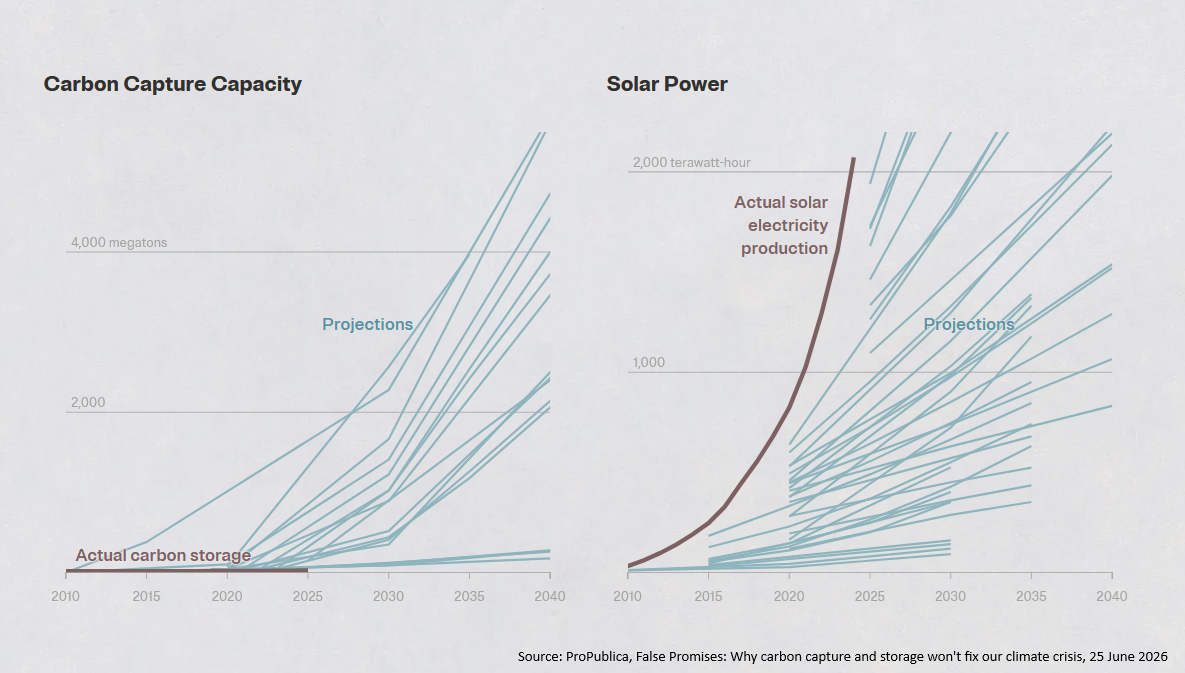
The reality of CCS, however, is very different. Practical problems with carbon capture have led to its repeated failure to materialise at scale, for decades. Projects consistently underperform or fail to emerge – and major proponents of the tech, fossil fuel companies like Equinor, keep scaling back. The technology is energy intensive and staggeringly expensive, costing far more to implement than simply switching to renewable energy. Meanwhile, the injection of CO2 deep into the earth’s rock can trigger earthquakes, and there are very real risks of CO2 leaking from underground storage, and from the pipelines – or ships – carrying it there. This could be lethal for the climate, and for human and animal life. In our recent report, Permission to Pollute, Corporate Europe Observatory presented the huge dangers from weakening permitting rules for CO2 pipelines – which the EU wants to build thousands of kilometers of, including through populated areas. You can find out more in the video – an extract from our recent webinar – below.
Advised by fossil fuel lobbyists, the EU has fallen for the idea of creating a market for this hazardous waste gas, underpinned by a vast CO2 pipeline network. Yet the idea that CCS will decarbonise energy-intensive industries not only ignores how complex and costly this would be, it disregards the need to reduce production and consumption as part of a just transition to a more sustainable economy. Instead of asking what industry we need, or who it benefits, carbon capture offers a (largely imaginary and wholly inadequate) sticking plaster over the social and environmental harms inflicted by powerful, polluting corporations. A sticking plaster that is now being applied in the case of data centres. Don’t ask, what are they for? Who are they benefitting? What harm are they causing? No, just whack a new fossil gas power plant up and say you have plans to capture its emissions.
Data centres: the newest lifeline for fossil fuels
The scale of the data centre build-out is difficult to imagine. In just three years, four Big Tech companies have poured a staggering $1 trillion into AI, mostly into the data centres powering these AI models. This build-out has put energy grids under increasing pressure, and has far outpaced the development of renewables. Increasingly, Big Tech companies are looking at the fossil fuel industry to feed their energy needs. According to the International Energy Agency (IEA) gas investments in 2025 were at a 25 year high mainly driven by the data centre build-out. The US is now investing more in fossil fuel power than China in what the IEA is calling an “AI-driven push”. Big Tech’s emissions are soaring thanks to data centres, and gone is even the pretence of ‘being climate front-runners’.
In Europe, too, the rapid build-out of data centres or ‘AI factories’ is having negative impacts on both people and planet. In Ireland, people are paying far higher energy bills, with data centre operators paying half what households do, while local communities are struggling to get access to the grid. Ireland’s 129 data centres account for almost a quarter of the country’s electricity demand. New fossil fuel infrastructure – including extra-polluting and harmful LNG – is being built to power data centres, leading to increased emissions and lasting harm to the climate, while at the same time providing a lifeline to the fossil fuel industry. You can learn more about Ireland, the canary in the coal mine of Europe’s data centre rush, in this video.
Ireland isn’t the only country suffering the ill-effects of Big Tech’s AI expansion. Spain, home to over 200 data centres, is already at risk of desertification in 75% of its territory, and the combination of the climate crisis and data centre expansion threatens ecological collapse. In the water-scarce region of Aragon, data centres’ immense water use is threatening farmer’s crops. Yet Amazon plans three new data centres in Aragon, at the same time as requesting to double the water consumption of its existing data centres – because, Amazon notes unironically, climate-induced heat waves mean they require more cooling. Local campaign group Tu Nube Seca Mi Río, which translates as “Your cloud is drying my river”, is calling for a moratorium:
“Neither people nor data can live without water,
but human life is essential and data isn’t.”
In the US, home to far more data centres than anywhere else in the world (over 4700), there is a huge amount of grassroots resistance – and now more than 500 moratoriums.
Despite this, the EU wants to triple Europe’s data centre capacity in five to seven years, with the Commission emphasising the importance of winning the “global race for AI”. Yet investigations by research organisation SOMO demonstrate that this expansion will primarily increase the wealth and power of US Big Tech companies and shareholders. Data centres in the EU are largely financed by US investors and tied-in to demand from US tech companies, reinforcing Europe’s dependency on US tech giants rather than fostering the digital sovereignty being promised. Music to the ears of Google, Amazon and Microsoft.
As with other polluting and energy-intensive industries, instead of asking fundamental questions about AI data centres – are they socially useful? at what scale? – the industry’s narrative of “more, more, more” goes unquestioned by policy-makers. Yet rhetoric about falling behind and looming capacity shortages contrasts with the reality that many EU data centres remain significantly underutilised – with some data centres running well below capacity (at as little as 6.1 per cent).
Despite this, the urgency ascribed to rapidly multiplying Europe’s data centre capacity is enabling the build out of new fossil fuel infrastructure to power them. What’s more, we’re starting to see this build out being accompanied by promises of carbon capture and storage, to clean up (ie greenwash) this fossil fuel industry revival.
This is because the expansion of data centres, which use vast amounts of energy (and water), is outpacing growth in renewable energy provision. But Big Tech’s answer is not to build enough new renewables, and pace its growth with its increase in renewable energy output. No, it’s answer – when it’s not cannibalising existing renewable electricity, which is already needed for other uses – is to build more gas power. The head of the European Data Centre Association (EUDCA) – which represents Big Tech titans like Amazon, Google and Microsoft – recently called on the EU to prioritise AI over the climate transition, and to power data centres with fossil fuels where necessary, as the EU’s data centre expansion goals, it said, cannot be met by other energy sources. (The lobby group later backtracked, “reaffirming” it’s commitment to “climate-neutral” data centres).
At the same time, fossil fuel companies are starting to market themselves not just as the providers of dirty energy to power this energy-intensive industry – they are promising “clean” fossil fuels for data centres thanks to carbon capture. (Spoiler: it still doesn’t exist.)
Carbon capture firms are jumping on the bandwagon too. Take Carbon Clean, which is backed by oil firms including Chevron and Aramco; it claims that the surge in data centre construction across Europe “is driving demand for carbon capture technology”. On-site gas-fired generation for data centres paired with their carbon capture systems, Carbon Clean says, “can reduce the unit footprint by 50%”. So, not decarbonised then, even theoretically, just – optimistically – halved. And in practice, capture rates for CCS projects have always been consistently far lower than promised.
Big Oil to Big Tech: “Your place or mine?”
Research from Greenpeace Australia shows how the frenzied rollout of AI data centres is set to derail the renewable energy transition and entrench gas – including data centre projects “framed misleadingly as ‘low carbon’ on the promise of carbon capture, an unproven technology that has persistently failed at every measurable level”.
Notably, Greenpeace Australia describes how fossil fuel corporations are quietly joining data centre lobby groups and attending their industry events, and vice versa, with the two industries reinforcing each other’s talking points and PR spin.
“Fossil fuel corporations are quietly joining data centre lobby groups and attending their industry events, and vice versa.”
There are signs of the same trend happening in Europe, where Big Tech and Energy are the #1 and #3 highest spending sectors on EU lobbying (€73 and €52 million/year respectively). Their high spending reflects the profits at stake in lobby battles around files like the Tech Sovereignty package and Cloud and AI Development Act. And their influence matches their spending, as the copy-paste scandal uncovered by CEO earlier this year revealed: Microsoft ghostwrote Commission legislation to keep data centre energy use secret. This battle around transparency is ongoing, with the delayed draft sustainability label disguising an array of ways for tech companies to greenwash their data centres, including allowing data centres that rely on fossil fuels to be labelled as green if they buy renewable or nuclear energy offset certificates.
With Big Tech and Big Oil’s interests aligning, there is growing cross-over in their PR and lobbying worlds. Big Tech lobby group Digital Europe’s members include Greek fossil fuel company Motor Oil, which received EU funds for its oil refinery CCS project.(2) Motor Oil took part in the European Commission’s recent Implementation Dialogue on CCS, an invite-only consultation that was populated almost entirely by fossil fuel and dirty industries. Motor Oil is also listed as a speaker (and sponsor) at EU hydrogen week in October 2026, alongside the Big Tech data centre lobby group EUDCA. BP is listed as a speaker at the Data Centre Congress in Amsterdam in October. Gas turbine manufacturers are piling on as sponsors to European data centre conferences, eager and confident that Europe will follow the US’ climate-wrecking path of embracing gas-fired AI data centres, as reported by DeSmog. Italian oil giant Eni, meanwhile, spoke at the Data Centre Nation Milan conference in May, where its head of data centre management said: “In an era where AI is redefining data centres as strategic “knowledge factories,” energy is no longer just a utility – it is the fundamental enabler of digital sovereignty… Eni is stepping into the AI race as a strategic, integrated partner for large-scale digital infrastructure.”
Eni: greenwashing data centres with “blue power”
Eni’s CCS plans go hand in hand with building new fossil gas power stations to power data centres. For example, the oil and gas corporation has teamed up with UAE-based AI firm MGX to “to develop state-of-the-art data centres in Italy” which will be “fully powered by blue power supplied by Eni, a low-carbon energy source generated by natural gas power plants, whose CO2 emissions are captured and stored”. A new dedicated fossil gas power plant will be built, with the promise of “CO2 capture and storage at the Ravenna CCS hub”. Ravenna is a highly controversial CCS project in northern Italy, including 100km of dangerous CO2 pipelines through populated, earthquake and flood-prone areas, as documented by ReCommon. Currently in its pilot phase, the project is spearheaded by fossil fuel firms Eni and Snam. The political influence of these corporations in Italy – against a backdrop of conflicts of interest and lack of transparency – has ensured policies that put the burden and cost of CO2 leaks onto the public, and secured exemptions to environmental impact assessments.
Eni’s chief executive claims that “data centres powered by blue energy” are “essential in the energy transition”. “Blue power” – supplied by Eni – is promised to be “a low-carbon electricity source” based on building new gas power plants that are “designed” to capture CO2 emissions. But lets be clear: none of this CO2 is yet being captured or stored – in fact, EU countries currently capture hardly any CO2 (around just 1 Mt per year) and permanently store none of it. Globally, we’re “permanently” burying less CO2 than a single large power plant can emit in a year. So when you hear about new fossil gas plants being built to power data centres, let there be no mistake: this just means new fossil fuels, with new emissions. Even if they're accompanied by distracting marketing lingo about “blue power” or “decarbonised gas”, these are little more than empty promises from companies that produce and sell gas, that a technology they’ve been promising and failing to deliver for decades, will soon make the gas they profit from “clean”.
“Empty promises from companies that produce and sell gas, that a technology they’ve been promising and failing to deliver for decades, will soon make the gas they profit from “clean.”
Eni, however, has been busy lobbying the European Commission on this topic. In the last year, Eni has met top-level Commission officials responsible for the Energy and Digital portfolios, to discuss CCS and data centres, the Cloud and AI Development Act, AI policies, and Eni’s data centre investments. The oil giant is also a member of influential big business club the European Round Table for Industry, which successfully lobbied for “streamlined permitting processes” for data centres to be a focus of the EU’s Clean Industrial Deal, and it’s follow up proposals. Eni was also present at the Commission’s recent ‘Implementation Dialogue’ on CCS, and it had six representatives in the CO2 infrastructure working group (set up as part of the Commission-run and fossil fuel dominated ICM Forum). This group’s recommendations for easier permitting and more public money for CCS infrastructure have been faithfully followed by the Commission. From the Industrial Carbon Management (ICM) Strategy to a new legislative proposal on CO2 infrastructure and markets expected from the Commission soon, this is a carbon coup in progress. A coup exemplified not only by the influence of the ICM Forum but by a biased and industry-skewed public consultation that is now being investigated by the European Ombudswoman.
ExxonMobil’s record reveals what CCS really is: a paper tiger
Another loud proponent of gas power with CCS for data centres is ExxonMobil. Exxon’s boss recently claimed that the oil firm wants to capture up to 90 percent of CO2 emitted by gas power plants that serve the data centre sector – describing itself as the “only realistic game in town” for data centres to be low-emission facilities. In the US, Exxon has teamed up with NextEra Energy to market huge new gas power projects with carbon capture as reliable “low-carbon” electricity for data centre operators. The oil giant has even claimed that by 2050, AI data centres could represent 20 per cent of the market for CCS. In its marketing materials, Exxon describes CCS as a “powerhouse technology for decarbonizing heavy industry”, with “limitless potential”: “CCS is here to stay, and we’re committed to being part of its legacy.” In a tongue-in-cheek reference to the lions and tigers and bears in the Wizard of Oz, one Exxon article is titled "Steel, ammonia and AI? Oh my! What can’t our CCS help decarbonize?”.
The problem is, if CCS is a tiger, it’s a paper one.
ExxonMobil’s glowing public optimism about CCS – including to create “Low Carbon data centres” – is a truly astonishing contrast to its statements elsewhere. Exxon casts doubt on carbon capture’s technical viability – describing CCS as “speculative” and long-term CO2 storage as “simply unproven”. Exxon moreover, admitted, point blank, in a UK parliamentary hearing, that it won’t pay for CCS: it wants governments to use taxpayers money to do that, because CCS is “not economic” and “does not make any sense” for companies otherwise.
There’s no doubt that Exxon – like other fossil fuel companies – wants public money for carbon capture, and it makes no secret that it lobbies for public support for CCS. But that doesn’t mean it is actually serious about making CCS happen – in fact, Exxon is suing the European Commission over provisions in the Net-Zero Industry Act that oblige oil and gas producers to contribute to the EU’s CO2 storage objectives (Art. 23). This obligation to contribute to CO2 injection capacity is something that Exxon has long been railing and lobbying against (including commissioning studies saying the EU’s CO2 storage targets aren’t achievable). When lobbying to prevent it didn’t pay off, Exxon began filing lawsuits. This summer, it filed a notice of dispute – the first step in a new lawsuit – using the investor-state dispute mechanism in the big polluter-friendly Energy Charter Treaty. (Which the EU has now withdrawn from, but corporations can still use to sue the EU for another 20 years). In a statement about the case, Exxon complained that compelling oil and gas companies to provide storage for captured carbon is “extremely costly” and could “break” Europe’s industrial base; the dispute, the Big Oil firm said, is “as much about saving Europe from itself as it is about the oil and gas industry fighting yet another irrational law from Brussels.”
This is a dynamic we see time and again in fossil fuel – and fossil-fuel-using – industry lobbying around CCS. They say that CCS is the answer, the solution to decarbonising their continued use of fossil fuels… but only if the public purse pays for it. And only on the condition that they are not held accountable for what they say it will do and when. To give another example of this dynamic playing out, in Denmark, most companies withdrew their CCS project plans when faced with the reality that government subsidies would include sanctions for non delivery.
Carbon capture is nothing more than a paper tiger – presented as a strong solution, but flimsy and ineffectual on closer inspection. It is the quintessential red herring – a distraction, promoted by big polluters, from the plain reality that stopping climate chaos means phasing out fossil fuels.
Let there be no mistake, as we come to the end of another summer in which Europe burned and thousands died from heatwaves: new fossil fuels to power data centres just means new emissions. No matter what PR is put out by the Big Tech-Big Oil bromance.
“Big Tech should be held accountable not just for its gas-guzzling data centres, but for the additional fossil fuels that AI is enabling to be extracted and burned.”
And for every unsubstantiated “AI will solve the climate crisis” claim, remember this: the services provided by data centres are already being sold to fossil fuel companies to increase extraction. AI is enabling fossil fuel expansion, as from exploration and extraction to refining and logistics, AI applications lower costs and sustain the economic viability of oil and gas resources that would not otherwise have been used. A recent study suggests that AI’s role in increasing emissions from boosting fossil fuel production far outweighs any climate benefits that AI applications in renewables might have. Big Tech should be held accountable not just for its gas-guzzling data centres, but for the additional fossil fuels that AI is enabling to be extracted and burned.
1: Based on the lobbyists that declare €1million+ in annual lobby spending – which means the total numbers for each sector will be even bigger.
2: IRIS (Innovative low caRbon hydrogen and methanol productIon by large Scale carbon capture) at Agioi Theodoroi refinery is expected to enter into operation in December 2029, and has received an EU Innovation fund grant of €126.8 million.
The views and opinions expressed in the publication are those of the mentioned organisation and do not necessarily reflect the position of all Real Zero Europe members.
Related resources: