Europe is still reeling from the worst heatwaves on record, yet the European Commission is proposing to worsen its already insufficient flagship climate policy, the Emissions Trading System (EU ETS).
Among the many new loopholes introduced by the proposal to benefit polluters, there are two in particular that our coalition, Real Zero Europe (RZE), wants to highlight:
The Commission has proposed to include permanent carbon removals in the ETS.
The Commission has proposed to add an extra 250 million tonnes of CO2 emissions allowances by 2040. The revenue from the sales of these allowances would be used by the Commission to purchase carbon credits from BioCCS and DACCS directly from operators and project developers. The Commission is also proposing that polluters can compensate for their own fossil emissions with BioCCS projects.
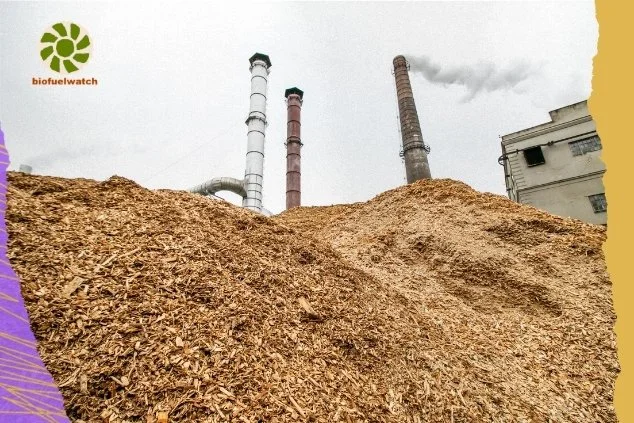
Carbon dioxide removal approaches, such as Direct Air Capture with Carbon Capture and Storage (DACCS) and Bioenergy with Carbon Capture and Storage (BECCS) are unproven, extremely costly and especially destructive if scaled. BECCS, along with other biomass-based removals such as biochar, stand to worsen forest degradation and biodiversity loss as they incentivize large-scale logging and wood burning. Not only would the Commission’s proposal reduce the meager effectiveness of the ETS by adding space to pollute regardless of the removals happening or not, but the methodologies for the certification of BioCCS developed by the European Commission are not robust enough to ensure that removals are even achieved.
Even more so as accounting rules under the EU’s Carbon Removals Certification Framework are so flawed that they will likely add GHG emissions to the atmosphere rather than removing them from it.
Both DACCS and BECCS are based on Carbon Capture and Storage (CCS), a technology prohibitively expensive, that has persistently failed to advance in over 50 years – both in terms of capture rates and storage integrity - and pose a risk to human health.
It is also proposing that polluting companies can purchase carbon offsets from 2036 onwards, in the form of international carbon credits.
Carbon offsetting schemes serve to prolong the fossil fuel-based economy. The scientific literature on carbon offsets is clear: they suffer from such intractable systemic problems that they are not fixable.
Carbon offsetting was initially part of the EU ETS, and offsetting was subsequently banned after nearly bringing it down. Adopting it now would show a remarkable immunity to learning.
Buying emission reductions achieved in the Global South to offset emissions in the EU is a dangerous form of climate colonialism that prioritises polluting corporations and the EU over lives and rights of people in the Global South.
Given the scale of climate catastrophe, for the EU to allow international offsets and technological CDR gives a lifeline to polluting industries such as the fossil fuel, agribusiness, plastics and petrochemical industries.
Integrating carbon removals into the carbon market is nothing short of carbon welfare. It rewards the very same energy intensive industries that have been sprayed with cash for the last 20 years for continuing polluting.
If Europe allows its polluters to rely on them, it is abdicating its responsibility for the climate crisis and handing polluters another free pass.
Today more than ever, we need a Real Zero climate policy.
We are calling on European governments and EU institutions to design and implement a Real Zero climate strategy instead of a corporate-captured ‘net zero’ strategy littered with dangerous distractions.
These are our demands:
A rapid, just, and equitable phase-out of fossil fuels. No new fossil projects, and a rapid phase-out of existing projects, avoiding dangerous climate distractions and techno-fixes
An energy transformation to real, fair, democratic, and sustainable renewable energy, and support for a just transition in the Global South
Support for small-scale farmers and a just transition of food and agricultural systems towards agroecology for food sovereignty
Close-to-nature forestry practices and careful restoration and protection of ecosystems that respect local populations’ rights
The redirection of public subsidies, away from fossil fuels and other harmful industries, to support these measures.
For media inquiries, please contact:
Tiziano Biagi, Communications Coordinator at Real Zero Europe
tiziano@fern.orgtiziano@fern.org