Bioenergy with Carbon Capture and Storage: Dangerous Hype
Written by: Almuth Ernsting, Researcher and Campaigner at Biofuelwatch.
In 2014, the Intergovernmental Panel on Climate Change (IPCC) published its fifth Assessment Report, with a startling conclusion about mitigation options: Limiting global warming to 2°C would almost certainly require deploying Bioenergy with Carbon Capture and Storage (BECCS) on a very large scale because greenhouse gas emissions could not be reduced quickly enough. This raised alarm bells amongst climate and environmental justice campaigners as well as some scientists. BECCS became widely seen as posing a major new threat of land- and water-grabbing and “unimaginable social and environmental impacts” as Friends of the Earth International warned.
Twelve years on, are there signs that the fears raised about impacts on land, water, ecosystems and communities are being realised? Well, no. Does that mean that we no longer have to worry about BECCS being pushed as a false climate solution? Equally no – but for different reasons than many had expected.
The only functioning BECCS projects involve carbon capture from ethanol fermentation, which is fairly simple and low-cost because it involves a pure stream of CO2 mixed with nothing but water vapour. However, the quantities of CO2 that can be captured from ethanol refineries this way are small – far smaller than the amount of CO2 emitted from burning fossil gas to run such refineries.
The reasons why carbon capture from burning biomass hasn’t been implemented at scale are simple: Carbon capture from power plants requires a lot of energy, thus reducing the amount of electricity and heat that companies can sell. It is expensive. The technology used for capturing CO2 from coal (tried in a few cases, each with significant technical problems) needs to be adjusted to contend with somewhat different flue gases from biomass burning. For all the hype and noise about BECCS, no company has invested any serious money in trying to overcome these technical challenges.
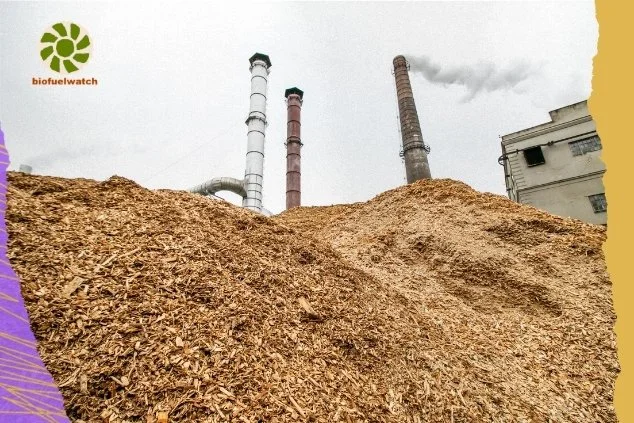
On the other hand, many billions of Euros in renewable energy subsidies have gone to power and heat plants that burn wood. As a result, wood burning for energy (not including traditional uses of fuel wood) increased by 50% between 2010 and 2021. In many regions, including the EU, this has led to more intensive logging degradation of forests, destroying habitats for wildlife and, at the same time, releasing large quantities of CO2 previously stored in forests and soils into the atmosphere. Across the EU, logging has been the main reason why the forest carbon sink is shrinkingand why, in some member states, forests have even become a net source of CO2 emissions. In 2021, around 500 scientists wrote an open letter to world leaders warning about the harm done to climate and forests by burning forest wood for energy. As the harms of large scale wood bioenergy are becoming harder to ignore, companies invested in this type of energy are increasingly resorting to “promises” of future carbon capture. At the same time, the fossil fuel industry and its political backers are writing “negative emissions”, including BECCS into their climate models and plans to create a false legitimisation for their refusal to curb fossil fuel burning.
Let us look at three examples of companies invested in biomass energy that have been boasting about BECCS.
Toshiba: An operational, successful BECCS project?
According to a 2024 Toshiba report about their Mikawa Biomass Power Plant in Japan, their “Demonstration Plant captures more than 600 tons-CO2/day which corresponds to more than 50% of emitted CO2”. This sounds impressive, but becomes less so on closer inspection. First, the Mikawa plant, which burns palm kernel shells, does not in fact capture any CO2 at present, nor was it doing so when the report was published. The report goes on to say that “this Sustainable CCS Project was carried out by 18 entities from FY2016 to 2020.” This, too, is misleading: there were no attempts to store any carbon, and the carbon capture trial happened between November 2020 and March 2021. The longest continuous period of carbon capture was 48 hours. The carbon capture demonstration plant has sat idle since early 2021 and Toshiba has not invested in any BECCS related projects since. Yet the International Energy Agency continues to list the Mikawa plant as an operational BECCS project in its database.
Drax Group, UK: Leaders in PR around BECCS
Drax operates the world’s largest biomass power station, which is also the UK’s single biggest emitter of CO2 and burns more wood than the UK produces in total, all of it imported. In 2025, Drax received over £2.7 million (3.15m Euro) in renewable energy subsidies every single day, without which they could not have afforded to operate their power plant. Drax’s reputation has plummeted since the BBC and other media outlets started reporting about them sourcing wood from primary and old growth forests in British Columbia, and from coastal hardwood forests in a global biodiversity hotspot in the southeastern USA, and from the clearcutting of biodiverse forests in the Baltic States. Drax has also been denounced for the harm its pellet plants in the southeastern USA cause, an environmental justice issue threatening primarily black communities in the southeastern USA.
Drax’s directors might have hoped to improve their company’s reputation when they announced at the Madrid UN Climate COP in 2019 that they planned to make their power station the first carbon-negative power plant in the world by 2030. Over the following years, Drax worked hard to create the impression that it was serious about developing the world’s first large scale BECCS project that, they claimed, would help the UK to (on paper) meet its “net zero” climate target. The company went as far as successfully applying for development consent for a gigantic carbon capture unit on its site. What they did not do, however, was invest or partake in any research and development other than allowing different companies to carry out small-scale product testing for new solvents on some of their flue gas.
Eventually, Drax succeeded in convincing the Government to grant them four years of further subsidies in addition to those they currently receive which are due to end in 2027. This without requiring Drax to commit to any carbon capture (although the new subsidies will cover only half the biomass presently burned by Drax). Soon after, Drax announced that it was suspending any carbon capture plans indefinitely, blaming the government – not their own lack of efforts to develop the technology – for that decision.
German startup company talking up BECCS while hoping for an environmental permit
Germany burns more wood than any other country in Europe, most of it for domestic heating, followed by small and medium-sized power and heat plants. A startup company called Hansekraft is proposing what would be the country’s single biggest biomass plant, which they want to build in Stade, a small town in Lower Saxony. The plant would burn half a million tonnes of waste wood. This might sound less bad than cutting down trees for energy. In reality, almost 90% of waste wood can be used to make panel board and other products, yet Germany burns 80% of its waste wood, causing panel board companies to mostly rely on forest wood rather than waste wood. This scale of waste wood burning, diverting from panel board manufacture, thus contributes ultimately to more logging. This in a country where forests have been devastated by the cumulative effects of the climate crisis (droughts, heatwaves, more bark beetle outbreaks) and excessive logging. Hansekraft is facing strong opposition from NGOs and from a group of local residents, who are also concerned about air pollution. Neither the company nor its directors have experience with carbon capture, yet they increasingly promote their planned power plant as one that would deliver ‘negative emissions’. It is hard to avoid the conclusion that, for Hansekraft, BECCS is a mere slogan to help them obtain the permits they need.
Conclusion
As the three examples from Japan, the UK and Germany show, the hype around BECCS is increasingly being used as a PR tool to help companies burning biomass on a large scale secure subsidies and political support. At the same time, promises of future "negative emissions" are used to legitimise both the biomass industry and continued fossil fuel use, based on the notion that BECCS will eventually deliver carbon-negative emissions. As long as those promises remain politically useful, they risk delaying a necessary move away from burning carbon-based fuels and towards genuinely clean renewable energy.
The views and opinions expressed in the publication are those of the mentioned organisation and do not necessarily reflect the position of all Real Zero Europe members.
Related resources: